Introduction
A destination that blends ancient temples, royal landmarks, vibrant markets and local cuisine. This itinerary is ideal for first-time visitors who want to experience the country’s highlights in one week, with practical advice on budgeting, transportation and accommodations.
Disclosure: This article contains affiliate links. If you book or purchase through these links, I may earn a small commission at no extra cost to you.
Before You Start Your Trip
Make your trip smoother by booking the essentials before following this itinerary.
- Compare Flights: Find the best flight deals and compare airlines before booking.
- Choose the Right Area: Not sure where to stay? Read our Where to Stay in Cambodia: Best Hotels for Every Budget guide to find the best neighborhood for your trip.
- Travel Insurance: Traveling around Southeast Asia? Flexible monthly travel insurance is a great option for longer, multi-country trips.
- Airport Transfer: Arriving at Airport? Book a private airport transfer in advance for a hassle-free arrival.
- Luggage Storage: Arriving before hotel check-in? Store your luggage and start sightseeing without carrying your bags.
- Stay Connected: Get an eSIM before you arrive so you have instant mobile data without needing to buy a local SIM card.
- Stay Protected: Protect your privacy and browse securely on public Wi-Fi with a trusted VPN.
Day 1 – Arrive in Phnom Penh: Royal Landmarks & Riverside Charm
Welcome to Cambodia! Begin your journey in the capital city of Phnom Penh, where French colonial architecture meets magnificent royal palaces and bustling local markets. After checking into your hotel, spend the afternoon exploring some of the city’s most iconic attractions.
Start at the Royal Palace, the official residence of Cambodia’s King. Built in the 1860s, the palace complex features beautifully manicured gardens, golden Khmer-style architecture, and several impressive buildings that showcase Cambodia’s rich heritage.
Next, visit the neighboring Silver Pagoda, famous for its floor made of over 5,000 silver tiles and its collection of priceless Buddha statues, including an emerald Buddha and a life-sized gold Buddha decorated with thousands of diamonds.
In the late afternoon, take a leisurely walk along the Sisowath Quay Riverside Promenade, one of Phnom Penh’s most popular gathering places. Enjoy views of the Tonlé Sap and Mekong rivers while stopping at cafés, bars, or restaurants for your first taste of Khmer cuisine.
Finish your day shopping at Central Market (Phsar Thmey), a striking Art Deco landmark where you can browse jewelry, clothing, handicrafts, souvenirs, and local snacks.
Recommended Time
- Royal Palace: 1.5–2 hours
- Silver Pagoda: 30–45 minutes
- Riverside: 1–2 hours
- Central Market: 1 hour
Food to Try
- Fish Amok
- Fresh spring rolls
- Khmer iced coffee
Day 2 – Phnom Penh History & Culture
Today is dedicated to understanding Cambodia’s modern history. While emotionally challenging, these sites provide important context about the country’s resilience and recovery.
Begin your morning at the Tuol Sleng Genocide Museum (S-21 Prison), a former high school that was converted into a prison during the Khmer Rouge regime. Exhibits include survivor testimonies, photographs, and historical information that document one of Cambodia’s darkest periods.
Continue to the Choeung Ek Genocidal Center (Killing Fields), located about 17 kilometers outside the city. Walking through the memorial grounds and listening to the audio guide offers a thoughtful and educational experience about the events that took place during the late 1970s.
In the afternoon, lighten the pace with a visit to the Russian Market (Phsar Toul Tom Poung). This lively market is an excellent place to shop for handmade crafts, silk scarves, artwork, spices, and souvenirs while sampling authentic Khmer street food.
Respectful Travel Tips
- Dress modestly by covering your shoulders and knees.
- Speak quietly and avoid disruptive behavior.
- Photography may be restricted in certain areas—follow posted guidelines.
- Remember these are memorial sites; treat them with respect.
Recommended Time
- Tuol Sleng: 2 hours
- Choeung Ek: 2–3 hours
- Russian Market: 1–2 hours
Day 3 – Travel to Siem Reap
After breakfast, travel to Siem Reap, the gateway to the world-famous Angkor Archaeological Park.
Transportation Options
- Domestic Flight: Approximately 1 hour; the fastest option for travelers with limited time.
- Bus: Around 5–7 hours; a budget-friendly choice with several daily departures.
- Private Transfer: Ideal for families or small groups seeking flexibility and comfort.
After arriving, check into your hotel and spend the afternoon exploring the city’s relaxed atmosphere.
Visit Pub Street, the heart of Siem Reap’s nightlife, where you’ll find restaurants serving Khmer specialties, international cuisine, cafés, and lively bars.
Nearby, browse the Angkor Night Market, which features locally made handicrafts, clothing, paintings, and souvenirs. It’s also a great place to sample Cambodian desserts and fresh tropical fruit.
Evening Suggestions
- Try traditional Khmer barbecue.
- Enjoy a relaxing foot massage.
- Watch a cultural dance performance if time permits.
Day 4 – Angkor Wat Sunrise & Ancient Temples
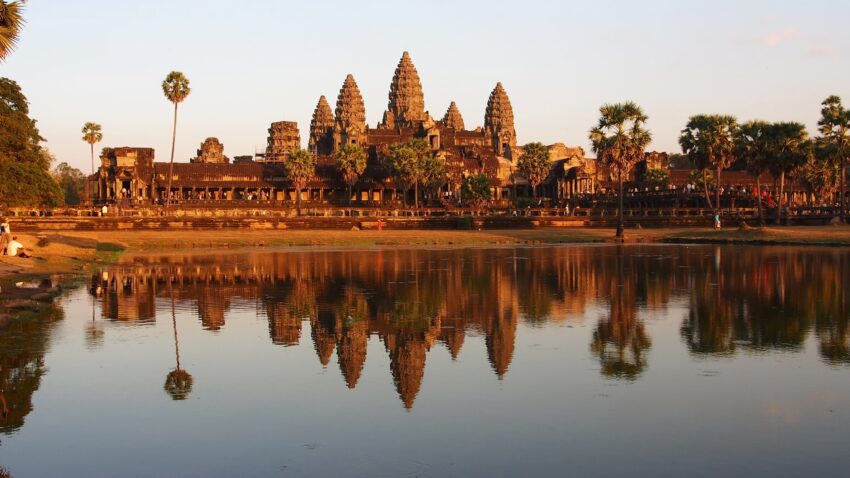
Wake before dawn for one of Southeast Asia’s most unforgettable experiences—a sunrise at Angkor Wat.
Arrive early to secure a good viewing spot as the temple’s iconic towers are reflected in the surrounding pools. After sunrise, explore the vast temple complex and admire its intricate bas-reliefs depicting scenes from Hindu mythology.
Continue to Angkor Thom, the ancient royal city built in the 12th century.
Highlights include:
- Bayon Temple, famous for its hundreds of smiling stone faces.
- Baphuon, a restored temple mountain offering panoramic views.
- The Terrace of the Elephants and Terrace of the Leper King, if time allows.
Tips
- Purchase your Angkor Pass in advance or the evening before.
- Wear lightweight clothing and comfortable walking shoes.
- Carry plenty of water and sun protection.
Recommended Time
- Sunrise: 5:00–6:30 AM
- Angkor Wat: 2–3 hours
- Angkor Thom & Bayon: 3 hours
Day 5 – Ta Prohm & Hidden Temple Gems
Today focuses on some of Angkor’s most atmospheric temples.
Start at Ta Prohm, made famous by giant tree roots growing over its ancient stone walls. Left largely in its natural state, it offers a striking contrast to the more restored temples.
Continue to Preah Khan, a sprawling temple complex with fewer crowds and impressive corridors, carvings, and courtyards.
Later, visit Banteay Kdei, known for its peaceful atmosphere and elegant architecture, before ending the day at Srah Srang, often called the “Royal Bath,” where many visitors enjoy sunset views over the reservoir.
Photography Tips
- Visit Ta Prohm early to avoid crowds.
- Bring a wide-angle lens for temple interiors.
- Respect barriers and avoid climbing on fragile structures.
Day 6 – Tonlé Sap Lake & Cambodian Culture
Experience rural Cambodia with a visit to Tonlé Sap Lake, Southeast Asia’s largest freshwater lake and a UNESCO Biosphere Reserve.
Choose between:
- Kampong Phluk, known for its stilt houses surrounded by flooded forests.
- Kampong Khleang, a larger and less-visited floating community that offers a quieter experience.
In the afternoon, join a Cambodian cooking class to learn how to prepare traditional dishes such as Fish Amok or Khmer curry using fresh local ingredients.
End the evening with an Apsara dance performance, where graceful dancers in elaborate costumes perform classical Khmer stories accompanied by traditional music.
Day 7 – Shopping, Relaxation & Departure
Enjoy a slower pace before your departure.
Spend the morning exploring Old Market (Phsar Chas), one of Siem Reap’s oldest shopping areas, where you can purchase handcrafted souvenirs, spices, Cambodian pepper, silk products, and locally made artwork.
Stop at a local café for freshly brewed Cambodian coffee or tropical fruit smoothies before treating yourself to a relaxing spa or traditional Khmer massage.
Depending on your flight time, transfer to Siem Reap–Angkor International Airport, allowing enough time for check-in and security.
Last-Minute Shopping Ideas
- Cambodian silk scarves
- Kampot pepper
- Palm sugar products
- Handmade ceramics
- Local artwork
By following this itinerary, you’ll experience Cambodia’s royal heritage, moving history, world-famous temples, vibrant markets and rich culinary traditions—all within one well-paced week that’s ideal for first-time visitors.
Ultimate Travel Packing List
Travel Bags & Luggage
Travel Documents & Money
Tech Essentials
- Universal adapter
- Multi-port USB charger
- Power bank (20,000 mAh recommended)
- Charging cables (USB-C, Lightning, etc.)
- USB-C hub or card reader (easy to forget)
- Portable luggage scale -> optional (only for budget airline)
- Luggage tracker (AirTag/Tile)
Content Creator Essentials
- Smartphone
- Camera (Optional)
- Action camera (DJI/GoPro)
- Drone (where legal)
- Tripod
- Phone gimbal
- Portable SSD (Great for your photography/documentary angle)
- MicroSD card (For DJI/action cameras) (bring at least 2-3)
- Extra camera batteries (if applicable)
- Wireless microphone
- Camera cleaning cloth (cloth + air blower)
- ND filters (optional)
- Camera charger
- Laptop (if editing while traveling)
Clothing
- Lightweight clothing
- Underwear & socks
- Sleepwear
- Comfortable walking shoes
- Flip-flops
- Swimwear
- Lightweight jacket
- Rain jacket or poncho
- Hat or cap
- Sunglasses
- Compression socks
Toiletries
- Toothbrush & toothpaste
- Deodorant
- Shampoo & conditioner
- Moisturizer
- Lip balm
- Sunscreen
- Reef-safe sunscreen (for beach destinations)
- Hairbrush or comb
- Razor
- Wet wipes
- Hand sanitizer
- Travel-size toiletries
Health & Safety
- Basic first aid kit
- Insect repellent (especially for Southeast Asia)
- Face masks (optional)
Flight Comfort
- Neck pillow
- Eye mask
- Earplugs or noise-cancelling earbuds
- Reusable water bottle
- Snacks
- pen (for immigration forms)
Outdoor Essentials
Optional Extras
scarf (optional for long flights)
Ziplock bags (great for wet clothes or electronics)
Conclusion
Cambodia is an excellent destination for budget travelers. Affordable accommodation, inexpensive local food, and reasonably priced transportation make it possible to explore the country without spending a lot.
Here are a few ways to save money:
- Stay in guesthouses or budget hotels.
- Eat at local markets and Khmer restaurants.
- Use buses instead of domestic flights where practical.
- Share tuk-tuk rides or join small-group tours.
- Travel during the green season (June to October) for lower accommodation prices.
- Purchase a multi-day Angkor pass if you plan to visit several temples.
With careful planning, many travelers can comfortably experience Cambodia for around US$35–60 per day, excluding international flights.

Jobless Diary is created to document my unemployment journey. Discover travel itineraries, hotel recommendations, destination guides and firsthand travel experiences.